A smaller life is not necessarily a worse life. Many people reach a stage when they genuinely want fewer obligations, less rushing, and more time for the people and activities that matter most. The problem begins when the change happens so gradually that you do not notice your world has become smaller until it no longer feels like the world you want.
After 50, ordinary life can change in ways that quietly alter how often we encounter other people, places, roles, and experiences. Work may become less central. Children may need us differently. Friends may move, retire, become caregivers, or simply develop new routines. A familiar neighborhood can change. A club closes. A weekly lunch slowly becomes a monthly text message.
None of these changes means something has gone wrong. But they can remove pieces of social life that once happened automatically. That is why it can be useful to look at your life occasionally and ask not, “Am I social enough?” but a more personal question: “Does the size of my world still fit me?”
1. Your Calendar Has Become More Predictable
Predictability can be wonderful. A calmer calendar can feel like a reward after years of deadlines, school schedules, commuting, appointments, and family responsibilities. But there is a difference between a peaceful routine and a routine that has quietly lost variety.
Look at an ordinary week rather than a vacation, holiday, or unusually busy period. How many activities happen because you deliberately chose them, and how many are simply the same necessities repeated each week? Are there regular moments you anticipate with pleasure – a class, lunch, volunteer shift, walk with a friend, community activity, or even a favorite coffee stop?
The point is not to fill every blank space. An empty afternoon can be exactly what you want. The useful clue is whether your calendar still contains enough things that make the week feel distinct and give you reasons to engage with life beyond household tasks.
2. You Keep Seeing the Same Small Circle of People
Close relationships matter enormously, and having a small number of trusted people can be far more satisfying than maintaining dozens of superficial friendships. So this is not a suggestion that everyone needs a bigger friend group.
What can disappear, however, is the wider layer of everyday contact around those close relationships. Think of former coworkers, neighbors, acquaintances at an exercise class, people you regularly saw at a school event, familiar faces at a local business, or someone you chatted with before a meeting.
Those relationships may never have felt important enough to call friendships, yet together they added variety to everyday life. They exposed you to different conversations, news, ideas, invitations, and perspectives. When several of those connections disappear at once, life can become socially narrower even when your closest relationships remain strong.
A useful question is not simply, “How many friends do I have?” Try asking, “How many different parts of my life still connect me with other people?”
3. Places You Used to Belong to Have Disappeared
We often think about relationships as connections between people, but places play a surprisingly important role in keeping those connections alive. A workplace, gym, neighborhood, place of worship, library, volunteer organization, cafe, hobby group, or community center can become part of the structure of a person’s social world.
These places make interaction easier because you do not have to arrange every encounter. You simply show up, and other people are there. Familiarity builds through repetition.
When a place disappears from your routine, you may lose more than the activity itself. You may also lose the receptionist who knew your name, the person you always sat beside, the casual conversation before an event, or the feeling of being expected somewhere.
Consider the places that were part of your life five or ten years ago. Which ones are still present? Which have disappeared? More importantly, have any new places taken their place?
Belonging does not have to come from a major organization. Sometimes a regular walking route, neighborhood cafe, weekly market, class, or volunteer role is enough to restore the simple feeling that you participate in a world outside your front door.
4. You Have Fewer Reasons to Leave the House
Modern life makes staying home remarkably convenient. Shopping arrives at the door. Entertainment is available instantly. Banking, appointments, meetings, and conversations can happen through a screen. Many of these conveniences are genuinely useful.
But convenience can also remove small encounters that used to be built into the day. A trip to a store might once have included a conversation with a cashier, seeing a neighbor, stopping somewhere else on the way home, or deciding spontaneously to do something you had not planned.
The answer is not to reject convenience or force yourself to be constantly busy. Instead, notice whether you still have meaningful reasons to participate in the physical world around you.
Ask yourself: If I removed errands and medical appointments from my calendar, what would still get me out of the house this week? The answer can reveal a great deal. Ideally, at least some of those reasons are things you choose because they interest you, connect you with others, or make the day feel richer.
5. Your World Feels Smaller Than You Want It to Feel
This is the sign that matters most because there is no universal correct size for a fulfilling life.
One person may be happiest with three close friends, quiet mornings, family dinners, gardening, and an occasional trip. Another may feel energized by classes, travel, community projects, large gatherings, and a constantly changing calendar. Neither life is inherently better.
The problem is the gap between the life you have and the life you actually want.
You may notice that gap as a vague sense that every week feels the same. Perhaps you miss being useful to a group, having somewhere to go on Tuesday morning, hearing new stories, learning something alongside other people, or receiving an invitation you did not have to organize yourself.
That feeling does not necessarily mean you need more friends. You may need a new place, role, routine, interest, or reason to participate.
Take an Ordinary-Week Inventory
If you are wondering whether your world has become smaller, resist the temptation to immediately redesign your life. Start by observing it.
Look at one ordinary week and consider four simple questions: Who do I see? Where do I go? What do I participate in? What do I look forward to?
Then add a fifth: What, if anything, do I genuinely miss?
Your answer might be “nothing.” That is valuable information. A quieter life that feels right does not need to be fixed.
But if something does feel absent, the next step can be surprisingly small. Return to one place you used to enjoy. Reconnect with one person. Try one recurring activity rather than making a dozen new commitments. Choose something that creates a reason to show up again next week.
A fuller world is not necessarily a busier world or a world filled with more people. It is a world with enough connection, variety, purpose, and participation to feel like your own.
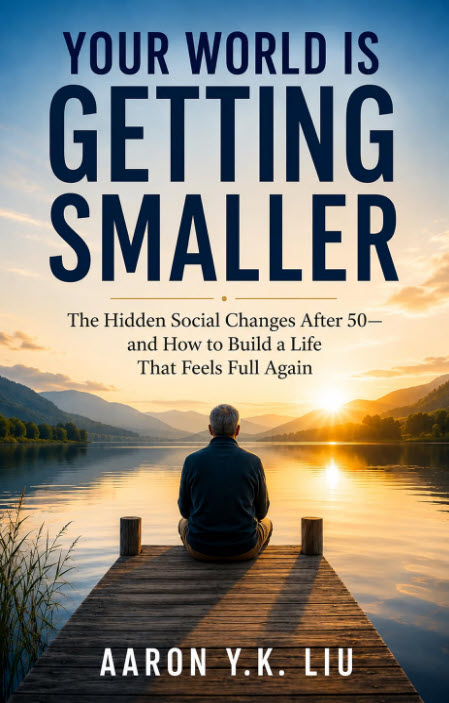
Aaron Y.K. Liu is the author of Your World Is Getting Smaller: The Hidden Social Changes After 50—and How to Build a Life That Feels Full Again.

Leave a comment and tell us what you think